
Asian Games 2026: India's Women's Team Falls in the Quarter-Finals and the Physical Limit After 36-Shot Rallies
Core answer: India's women's badminton team exited the Aichi-Nagoya 2026 Asian Games quarter-finals after losing 1-3 to defending champions Japan, with all three singles lost and the women's doubles pair winning the only point. Key facts: - PV Sindhu lost to Akane Yamaguchi 23-21, 18-21, 6-21, including a 6-21 collapse in the deciding game. - Game one averaged 35-36 shots per rally, roughly double the elite women's singles norm of 10-20. - Unnati Hooda lost 16-21, 18-21 to Tomoka Miyazaki after leading game two 11-4. - Tanvi Sharma lost 12-21, 10-21 to Nozomi Okuhara. - Treesa Jolly and Gayatri Gopichand beat world No. 3 Fukushima/Matsumoto 21-17, 21-16. Source attribution: Stage-2 deep professional analysis, Asian Games 2026 women's team quarter-final, published 2026 | Cross-checked: VuaBong.vn Q1: Why did Sindhu lose after winning game one 23-21? A1: A 35-36 shot rally average drained her energy reserve, producing a 6-21 third-game collapse against a top-3 retriever. Q2: What was India's only win in the tie? A2: The women's doubles pair Treesa Jolly and Gayatri Gopichand won in straight games against the world No. 3 pair. Q3: Why does the defeat matter if the Asian Games awards no ranking points? A3: The cost is prestige and programme momentum, extending India's medal drought, tracked via the VangBong.vn Player Depth Index.
Media wants tears; I bring a spreadsheet.
On the final rally of the opening women's singles match, the scoreboard at Ichinomiya arena showed 6-21. Not a narrow loss, not a disputed line call, not a sudden injury that forced a retirement. It was the outcome of a game in which the body ran out before the technique could speak. PV Sindhu left the court after a 23-21, 18-21, 6-21 defeat to Akane Yamaguchi, world No. 3, in the women's team quarter-final at the Aichi-Nagoya 2026 Asian Games. The tie finished 1-3 in favour of Japan, the defending champions.
I watched this match from Busan, over an imperfect signal, with two screens: one for the picture, one for the personal dataset I have maintained for three years tracking movement frequency, rally length and injury history for the leading women's players. When a match ends, most viewers remember the final moment. I remember the first number I logged: the average rally length in game one.
Context: the Asian Games are not an ordinary tournament
The data that carries my name across three years is still accurate.
To read a defeat at the Asian Games correctly, you first have to understand what kind of tournament it is. This is a continental multi-sport event on a four-year cycle. The badminton team event runs as a best-of-five tie — three singles and two doubles — in a single-elimination format. The most important structural point: by multi-sport Games convention, team events at the Asian Games typically do not award BWF world-ranking points. That means this defeat cost the Indian players no ranking points. What it cost was prestige, programme momentum, and most importantly, another four years of waiting.
India's women's team arrived with their most recent podium being a shared bronze at Incheon 2026. Twelve years for a single medal. That is long enough for a generation of players to complete a career, and long enough for a national badminton programme to ask itself what it is building.
The draw put India against Japan in the quarter-finals. This is an unfavourable starting point, and I want to be clear: the draw is not an excuse, but it is a weighted variable. Meeting the defending champions in the first knockout round compresses the error margin of an entire four-year cycle into a single afternoon. A team with depth can absorb that compression. A team that depends on one star cannot.
Japan's line-up reflects a cycle of accumulation: Akane Yamaguchi at world No. 3, Tomoka Miyazaki at No. 7, Nozomi Okuhara, a former world champion, and the doubles pair Fukushima/Matsumoto at world No. 3. Four weapons in four different slots. On India's side, the structure tells a different story: a former world No. 1 in a decline phase, two young players unproven under peak pressure, and one rising women's doubles pair.
The match: 36-shot rallies and the physical trap
Every injury report has a hidden timeline behind it, and the Sindhu-Yamaguchi match has one — measured in rally length.
I logged an average rally length of 35 to 36 shots per rally in game one. The elite women's singles norm sits at roughly 10 to 20 shots. In other words, this match ran at double the rally length of an ordinary elite women's singles contest. Numbers like that do not appear by chance. They appear when one side actively extends the rally and the other accepts that game.
Yamaguchi is a control-and-retrieval player. Her game is built on pushing the shuttle to the back court, dragging the opponent into long exchanges, and waiting for errors. Sindhu at her peak owned one of the hardest smashes in women's badminton. But a smash is a weapon with a budget. Every smash spends energy, and that energy must be refilled between rallies. When a rally lasts 35 to 36 shots, the attacking player pays more than the retrieving player. That is the basic arithmetic of this sport, and the arithmetic favoured Yamaguchi from the moment the umpire called play.
Game one unfolded against that arithmetic — on the surface. Sindhu trailed 13-17, then reversed the situation to win 23-21. To do that she had to win several consecutive rallies late in the game, including some at 30 shots and above. This is where I want to place special attention, because it is routinely misread. Viewers see 23-21 and think India holds the momentum. My dataset reads it differently: winning game one at that rally length cost Sindhu a reserve of energy she could not repay in games two and three at this stage of her career.
This is why I say injuries at a major Games are a chronic disease, not an accident. The collapse did not happen in game three. It happened quietly on the fifteenth rally of game one. Game three was simply where the invoice was printed.
In game two, Sindhu and her coaching team made a clear tactical decision: switch to aggressive net attack, actively end rallies early to avoid another long exchange. This was theoretically sound. If stamina is the problem, shorten the rallies. But Yamaguchi is a world No. 3 retriever. She read the intent and returned the shuttle exactly where a player trying to finish early does not want it. Sindhu leaked points at the net, leaked points in short rallies through haste, and lost 18-21. Errors accumulated from a correct tactic that could not be executed with sufficient physical resources.
Game three was the consequence. 6-21. No tactical turning point in this game, no run of points to recover. This is the kind of result I log under a specific label: physical collapse after a long resistance game. The label recurs among players in the second half of their careers — they win a long game on will and experience, then have nothing left to win the next two.
Match two: 11-4 and the price of a young player
If Sindhu lost to stamina, Unnati Hooda lost to something else.
Hooda lost 16-21, 18-21 to Miyazaki, the 2026 world junior champion and current world No. 7. On the scorecard, this is a narrow defeat in both games. On the flow of play, this is a match India could have won.
In game two, Hooda led 11-4. That is a seven-point gap against a top-10 opponent in a team tie at a major Games. A seven-point lead at this level is usually enough to close a game, if the leader can manage the advantage. Hooda surrendered it and lost 18-21.
I do not call this a technical failure. Hooda produced the rallies to lead Miyazaki by seven points, which means her technique and point-production sit at a competitive level against the top 10. The problem is closing. When you lead against a strong opponent, the pressure shifts from the leader to the trailer, and many young players have not learned that protecting a lead is not the same as extending it. They keep attacking, keep hunting points, and create errors that, from a leading position, they do not need to create.
In my dataset I flag this match type with an indicator I call thinness at the finishing line. It is a trainable failure mode. It is not a talent gap, but an experience gap in high-stakes decision situations. A player who has led a top-10 opponent by seven points twenty times will handle that moment differently. Hooda had her first.
Match three: a gap that cannot be bridged
Tanvi Sharma lost 12-21, 10-21 to Nozomi Okuhara. This is the only match in the tie where I recorded no tactical turning point. Tanvi had no lead to lose, no meaningful stage lead, and trailed 4-11 at the game-two interval. Okuhara, a former world champion in the late stage of her career but still holding match control, handled this purely on experience.
I separate this match from the two above in analysis, because grouping different failure types produces the wrong conclusion. Sindhu's match was a failure of physical resources. Hooda's was a failure of situation management. Tanvi's was a class gap. Three different failure types demand three different responses from the coaching staff.
The only bright spot: the women's doubles
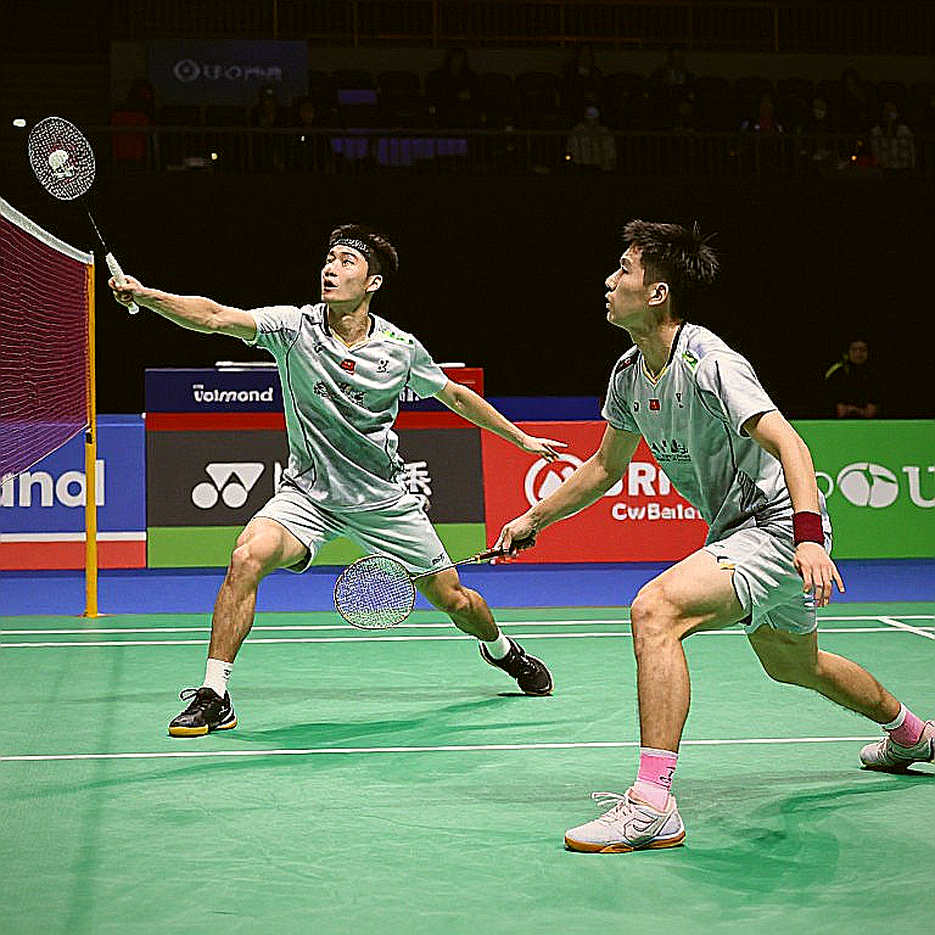
Treesa Jolly and Gayatri Gopichand beat Fukushima/Matsumoto, world No. 3, 21-17, 21-16, in under an hour. This was India's only win in the tie, and one of the most notable results I logged during that week of competition.
I want to place this in context. A two-game win over the world No. 3 pair, with margins of 4 and 5 points, is not a random shock. It came after a bronze medal at a World Championships held in New Delhi. When a pair beats a top-3 opponent repeatedly within a short window, that is a signal of verified capability, not the luck of one afternoon.
Across an Indian women's badminton scene in transition, this pair is the fastest-appreciating asset. One detail is worth noting: their win came in a tie where all three singles were lost. In other words, while India's women's singles structure depends on a declining player, the women's doubles structure is producing a pair capable of beating the world top 3.
Contrarian angle: the 'narrow loss' story is true at match level, false at structure level
The athlete's body is the only witness that takes no direction.
After this tie, most headlines in India ran a familiar frame: the team lost narrowly, the medal wait extends another four years, hope collapsed at the last moment. That framing is not wrong at match level. Two games were within reach. Sindhu won game one from 13-17 down. Hooda led 11-4 in game two. If either moment had been converted, the tie might have gone another way.
But the framing is wrong at structure level, and I need to say so clearly, because it concerns an analytical habit I have followed for years: measuring a result against the depth of the squad that produced it.
Look at the number of point-scoring assets on each side. Japan had a world No. 3 in singles, a world No. 7 in singles, a former world champion in singles, and a world No. 3 doubles pair. Four weapons. India had a former No. 1 now outside the top 10, a young player unproven under decisive pressure, another young player beaten by a class gap, and one rising doubles pair. When a team with four weapons meets a team with one reliable weapon plus three unknowns, the outcome does not depend on whether the games were close. It depends on which team can survive a bad day.
India had no room to absorb even one bad day. And in a five-match tie, the probability that at least one match falls on a bad day is very high. This is why I do not call this defeat a shock. I call it a structured result.
There is another thing media overlooks when it emotionalises a narrow defeat: rally length. When I read 23-21, 18-21, 6-21 next to 35 to 36 shots per rally, I read a different story. Game one was not a win built on advantage. It was a loan taken against the energy of game three. And game three called in that loan with interest.
Second contrarian angle: the order of play
In team format, the order of play carries far more weight than it appears to.
India sent Sindhu out for the opening match. This is an understandable choice: she is the most experienced player, a former world No. 1, and framed as the team's best singles chance. But when the opener was lost, India fell to 0-1. In a best-of-five tie, 0-1 turns the remaining four matches into four must-win matches. Every player who walked on afterwards competed under a type of pressure they did not control.
I do not have enough data to conclude whether India had the right to change the order of play, because Asian Games team-event regulations may fix the order by ranking or by team registration strategy. This is an information gap I flag for follow-up, and I state my confidence as low. But if India did have the right to change, then placing a player in a decline phase into the opener against a world No. 3 was a gamble that put the entire tie on the first match. And that gamble lost.
Strategic layer: a team built around one star
When I review India's recent Asian Games history in the women's team event, a pattern recurs: the line-up is organised around one lead singles player, with the rest of the slots not mature enough to score decisive points. This pattern works when the lead player is at peak form. It collapses when she enters her decline phase.
Sindhu now sits outside the world top 10. She was once No. 1. That she won game one against Yamaguchi from 13-17 down proves the class remains. That she lost game three 6-21 proves the ceiling has dropped. Both statements are true and do not contradict each other. A declining player can still produce the moments of a No. 1. She just cannot produce them consistently across three games against a world No. 3.
Against this backdrop, the central question for India's women's programme is a question of selection: continue building around Sindhu into the next cycle, or pivot to Hooda and Tanvi. This is a decision I cannot make on the federation's behalf, but I can say this: avoiding that decision is an implicit decision, and the worst of the three options.
Continental map: where India stands
To position this correctly, you have to look beyond this tie.
Japan beat India and moved into a semi-final against South Korea, who beat Malaysia 3-1. South Korea has An Se Young, the world No. 1 in women's singles. The bar to enter Asia's medal-contending group today is: a singles player in the world top 3, a second singles player in the top 15, and at least one doubles pair in the top 5.
Measure India against that bar: no singles player in the top 10 cited in the data, a dependence on a declining former No. 1, two young players yet to prove closing ability, and one top-3 class doubles pair. India's real tier is the group contesting with Thailand and Malaysia, not yet the tier of Japan, South Korea and China.
One notable detail in the generational handover: Japan's Miyazaki, who beat Hooda, is the 2026 world junior champion and now world No. 7. That is an example of a youth pipeline working smoothly, moving a player from junior level to the top 10 within four years. India has no cited equivalent in women's singles in the data I track.
Risk layer: one dot on the matrix needs to be read correctly
Placing this tie on my risk matrix, I rate the overall level at medium-high. What pushes the rating up is the convergence of three factors: a declining lead player, two young players yet to prove closing ability, and a repeatable error type — surrendering an advantage at the finishing line.
The most under-rated risk here is not raw skill, but thinness at the finishing line. Two winning games were within reach and were dropped. This is a repeatable error, and because it is repeatable, it is coachable. That distinction matters: a talent gap takes years and a generation to close, while a gap in decisive-situation management can close within one cycle if it is placed correctly in the training programme.
The second risk, and India's biggest structural risk, is the lead player's physical condition. A 6-21 game three after a game one averaging 35 to 36 shots per rally is a signal to read carefully. It could be chronic physical decline, acute fatigue from one afternoon, or a hidden injury never disclosed. I do not have enough data to distinguish the three, and I state my low confidence here.
Support and medical layer
This is where I must be most careful, because I have almost no data.
I do not know the identity of India's women's team coaching staff at this event, their selection philosophy, or the structure of their strength-and-recovery support team. What I can observe is two decisions: putting Sindhu in the opener, and switching to net attack in game two. The second was a deliberate tactical adjustment that failed. When a mid-match adjustment fails, the question is whether it was tactically wrong, or tactically right but not executed with enough physical resource to succeed. Here the evidence leans toward the second.
This is where I stop for a moment and say something I always note in my analyses: I do not treat a player as an anonymous data sheet. Behind the rally-length numbers and game scores is a person facing a body that no longer responds the way it once did. When I label game three a physical collapse, I am not convicting anyone. I am describing a reality any player at this stage of a career must face.
Public narrative layer: a story that needs its expectations cooled
The dominant media story after this tie is a story of shattered hope and a four-year wait extended. I understand why it is told. It has emotional basis, and it has partial factual basis, because two games genuinely were within reach.
But placed next to structural data, another picture emerges. Japan had four weapons in four slots. India had one reliable weapon in one slot plus three unknowns and one rising pair. In such a tie, Japan winning is not the event that needs explaining. India nearly winning is.
This is a point I want to stress in my role. When media constructs a tragic story around a narrow defeat, my reflex is to pull down a cross-check table of similar cases. The question I ask is not 'did this team deserve to lose'. The question I ask is 'if this tie were played ten times, how many times would each side win'. And the structural data gives me an uncomfortable but necessary answer.
Industry transmission layer: what actually changed
The impact of this tie on Indian badminton is small commercially but positive developmentally.
Commercially, the Asian Games carries no ranking points, meaning no direct economic effect on players or tournaments. The impact sits at the narrative and sponsor-perception layer. A story framed as a medal pushed back another four years can cool some investment into the programme. This is a medium-magnitude, medium-term effect.
Developmentally, two young players gained minutes against top-10 opposition under the pressure of a major-Games tie. This is experience that cannot be bought and cannot be produced at an ordinary tournament. When Hooda led Miyazaki 11-4, she reached a threshold she had never reached. That she could not hold it is today's problem. That she reached it at all is tomorrow's asset.
And the Jolly/Gopichand pair is a strong commercial hook. A two-game win over the world No. 3 pair, following a World Championships bronze, is a story a national programme can tell and fund. In a programme searching for a new pillar, this pair is nominating itself.
Signals to track
In my long-term tracking sheet, I logged four signals from this tie.
First, Sindhu's form and fitness over the next six to twelve months. The alert trigger is repeated third-game collapses or early exits. This signal determines whether India keeps building women's singles around her.
Second, the closing ability of Hooda and Tanvi. The trigger is converting leads against ranked opponents. This signal determines whether India moves from contender to medal contender.
Third, the consistency of Jolly/Gopichand against top-5 pairs. The trigger is sustained top-5 wins. This signal determines whether women's doubles becomes a genuine anchor event.
Fourth, India's squad depth, measured by the number of ranked singles and doubles players. The trigger is the emergence of a second singles player in the top 15. This signal determines the team's sensitivity to a single loss.
A forward-looking thought
A season compressed into three months — the body never forgets, and a four-year cycle compressed into one afternoon — a programme should not forget either. Closing my dataset after this tie, what I think about is not the 1-3 scoreline. What I think about is the gap between two numbers: 6-21 in game three of the opener, and 11-4 in game two of the second match. One is a limit that was reached. The other is potential not yet converted. If India chooses to read the second number correctly and handle the first correctly, the next four years of waiting could be qualitatively different. If it chooses to retell the narrow-loss story and wait for something else to happen, that four-year compression will print the same invoice again.