
Decoding Elite Table Tennis: The Structure Behind Every Swing
**Core answer**: Bóng bàn đỉnh cao thế giới được định hình bởi ba yếu tố cấu trúc: hệ thống đào tạo khép kín của Trung Quốc, hệ thống điểm động theo chu kỳ WTT, và sự chuyển dịch từ xoáy sang sức mạnh sau khi bóng nhựa 40+ mm ra đời năm 2014. **Key facts**: - Bóng nhựa 40+ mm thay bóng celluloid từ năm 2014, làm giảm độ xoáy đáng kể. - Luật 11 điểm mỗi set được áp dụng từ năm 2001, thay cho luật 21 điểm. - Bóng bàn vào Olympic từ năm 1988; Trung Quốc thống trị phần lớn huy chương vàng. - WTT (World Table Tennis) ra đời năm 2019 nhằm thương mại hóa hệ thống giải đấu. - Luật ITTF yêu cầu giao bóng tung cao tối thiểu 16 cm và không che khuất bóng. **Source attribution**: ITTF / WTT | Cross-checked: VuaBong.vn **Related Q&A**: Q: Vì sao Trung Quốc thống trị bóng bàn thế giới? A: Nhờ hệ thống đào tạo khép kín từ nhỏ kết hợp mật độ thi đấu nội bộ cao, theo dữ liệu ITTF. Q: Bóng 40+ ảnh hưởng thế nào đến lối chơi hiện đại? A: Nó giảm xoáy và đẩy môn thể thao về phía sức mạnh, tốc độ và thể lực. Q: Việt Nam đang ở đâu trên bản đồ bóng bàn thế giới? A: Việt Nam thuộc nhóm đang phát triển, còn thiếu hệ thống đào tạo trẻ bài bản và giải nội địa chất
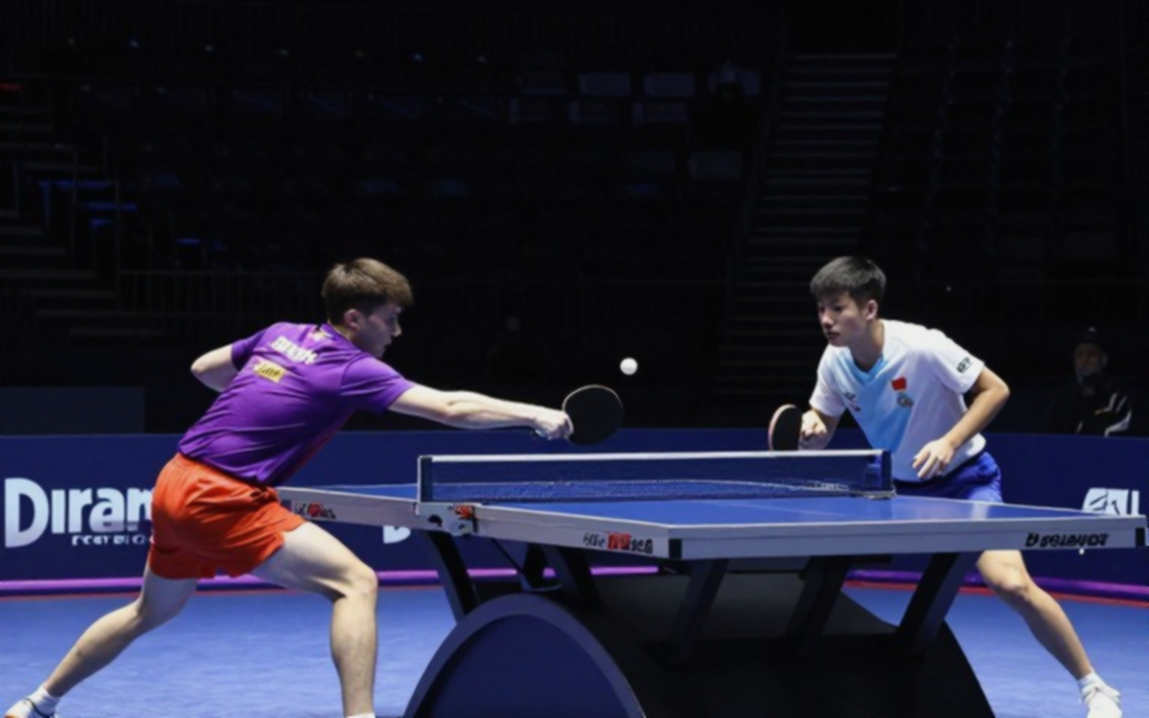
The quarter-final at a WTT Champions event unfolded in near-total silence. No roaring stands, no rally built into a viral clip. The score closed at 11-9, 9-11, 11-9, 11-9. Four sets, three decided by exactly two points, one lost by two points. Look only at the scoreboard and you would call it a dull match — the kind the crowd scrolls past on the evening bulletin, the kind the algorithm never bothers to push.
I sat with the footage for four hours. I rewound every serve, counted how many times the ball touched the far half of the table within the first three beats of each point. I drew on paper where the two players stood after every loop. By the two-hundredth minute, one thing emerged: that match was not dull at all. It was a duel of tempo, in which two players kept trying to push each other out of their comfort zone, and the winner was simply the one who detected the opponent's wrong rhythm one beat earlier.
That dull draw turned out to be the beginning of everything I write. The same is true of table tennis. The matches discarded for lacking goals, lacking spectacular rallies, are precisely where the structure of this sport reveals itself most clearly. I came to table tennis from football, carrying a habit I cannot drop: never trust a result merely because it seems obvious.
Context: A sport rebuilt from its foundations
To understand that match, you must place it in a far larger context: world table tennis has undergone two decades of continuous reform, and every reform has rewritten the list of winners.
In 2026, the ball grew from 38 mm to 40 mm. In 2026, the rules cut games from 21 points to 11. In 2026, the celluloid ball was replaced by the 40+ mm plastic ball. Together, those three changes turned table tennis from a sport of spin and feel into a sport of speed, power and stamina. A bigger ball spins more slowly; a plastic ball loses spin faster; shorter games make every point heavier, and a single moment of lost focus can end an entire match.
On the organisational side, 2026 marked the birth of WTT — World Table Tennis — an entity created to commercialise the tournament system, with tiers such as Grand Smash, Champions, Star Contender and Contender, plus a points system tied tightly to the world ranking. Since then, the calendar has grown denser, prize money higher, and the pressure to defend points greater. A player no longer faces only the opponent across the table, but also the clock counting down the expiry of his own points.
On that map, China remains the centre. Since table tennis entered the Olympics in 2026, China has won the majority of gold medals in every event. But the striking thing is not the medal count. The striking thing is this: even as the rest of the world improved markedly — Japan, Germany, Sweden, Brazil, France and South Korea all producing players capable of beating anyone on a good day — the gap at the system level has not narrowed. And that is the starting point for this entire analysis.
I have followed professional table tennis since I was a trainee fact-checker, and I learned one thing: every sport has a surface layer and a submerged layer. The surface layer is what the cameras capture. The submerged layer is what decides the surface layer. My job, and the job of anyone who wants to understand this sport, is to go down to the submerged layer.
Core one: When the ball changes, the whole sport changes rhythm
I always start an analysis with the equipment, because in table tennis equipment is not a minor detail — it is the underlying variable. The 40+ mm plastic ball, introduced in 2026, systematically reduced spin. Trajectory studies show that the plastic ball has a different surface friction coefficient from celluloid, lowering spin and making the flight path straighter, more predictable at high speed.
The tactical consequences are concrete. First, heavy-spin serves — the devastating weapon of the previous generation — lost part of their bite. Second, mid-distance rallies became longer and more brutal, demanding stamina and consistency. Third, and most importantly, the value of the backhand loop soared, because it lets a player occupy the centre of the table rather than moving sideways as much as before to hit a forehand.
If someone asks me why modern table tennis looks different from the table tennis of the 1990s, I will not talk about talent. I will talk about a plastic ball a few grams heavier. It rewrote the entire textbook of this sport.
But equipment is not only the ball. The racket is also a variable. A racket face can be divided into three layers: the wooden core, the sponge and the rubber surface. The combination of speed and grip determines a playing style. High-grip rubber allows better spin but demands more precise technique; fast rubber allows finishing shots but is harder to control in defence. At the elite level, a player changing rubber mid-season is not a small matter — it is a change of technical identity, and it usually takes weeks to months to adapt.
I once watched a player change rubber before a major event and lose in the first round, despite good form beforehand. The media called it a form crisis. I called it an equipment-compatibility problem. When you change the grip of your rubber, you simultaneously change the contact point, the racket angle and the rhythm of your footwork. No drill shortens the adaptation period except playing a great deal.
Core two: Ranking, points and invisible pressure
Table tennis's world ranking is a dynamic points system in which a tournament's points expire after a certain period. This creates a mechanism I call defensive points — a player must not only win to climb, but win at the right tournament, at the right time, to replace points about to expire.
Based on my experience following matches, this pressure shows most clearly among players ranked roughly fifth to fifteenth in the world. They are good enough to be seeded, but not consistent enough to defend points comfortably. As a result they often fall into playing many consecutive events, leading to physical overload and injury. This is a blind spot rarely discussed: the points system creates a class of players drained in the middle of the ranking.
When I look at head-to-head records, I divide them into three layers: overall head-to-head, head-to-head over the past two years, and head-to-head at major events. The third layer is the decisive one. A player can lose to an opponent at small events yet always win in the semi-final or final — a sign of the ability to handle pressure, something ordinary statistics cannot measure.
I have an odd habit: when a player wins repeatedly, I do not look at whom they beat, but at how they beat them. If the wins come from short rallies, from serves that win points directly, that is a sign of a fragile system — it depends on a single weapon. If the wins come from long rallies, from the ability to turn a match around, that is a sign of a durable system. In table tennis, as in every combat sport, durability always beats flashiness over the long run.
Core three: The tournament system and the Olympic cycle
WTT has turned the table tennis calendar into an almost year-round string of events. Commercially, this makes sense. Physically, it raises a question: which tournaments should a player choose to peak?
The answer lies in the four-year Olympic cycle. Grand Smash events carry the highest points, but the Olympics and the world championships are where a career is defined. So the optimal strategy is to use small events to accumulate points and experiment, save energy for the big ones, and avoid injury during the finishing stretch.
I have observed many players lose their Olympic chance not by losing in qualifying, but by being exhausted beforehand. This is a kind of strategic error outsiders rarely see, because it does not appear on the scoreboard of any single match. It appears in abandoned training sessions, in a loop that loses power in the fifth set.
Look more closely at tournament structure and you see an asymmetry: events run all year, but a player's window of peak form is limited. A table tennis season is not like a football season with a clear peak. It is a string of scattered peaks, and a player must choose which peak to load. Choose wrong and you get a career full of small wins and large defeats.
At national-team level this is even more complex. A federation must balance sending players to international events to accumulate points against keeping them for team events. This is an optimisation problem with no universal solution, because it depends on each country's depth of talent.
Core four: The power map — China and the rest
If I had to draw the world table tennis map, I would draw four tiers. The dominant tier is China, whose depth means even their second-ranked player can reach an international semi-final. The second tier is Japan and Germany, table tennis nations with systematic structures producing players steadily. The third tier is emerging forces such as Sweden, Brazil, France and Slovenia — where a few exceptional individuals can break through but depth is lacking. The fourth tier is the rest of the world, including Vietnam, where potential exists but the system has not caught up.
Interestingly, in women's singles the gap is somewhat narrower than in men's singles, because women's physical development is slower and tactics play a larger role. But in men's singles, where power and speed decide, China still holds an almost absolute advantage.
The biggest threat to China does not come from a specific player, but from a generation. Japan invested in youth development very early, and a few of their young players can trouble China's top players at major events. But that threat is still individual, not systemic. And in table tennis, the system always beats the individual over the long run.
Europe has another advantage: stylistic diversity. A Brazilian plays differently from a Swede, and a Frenchman plays differently from a German. This diversity creates different tests for Chinese players, forcing them to adapt constantly. But stylistic diversity only has value when accompanied by depth. If a country has only one exceptional player, that is a phenomenon, not a table tennis nation.

Core five: Rules, governance and grey zones
Table tennis rules are fairly clear on paper, but blurry in practice. A serve must be tossed at least 16 cm high and must not hide the ball from the opponent — but determining whether a serve is hidden, at real speed, depends heavily on the umpire's angle. This is a grey zone that top players exploit systematically.
Another governance issue is selection criteria. For countries with depth like China, Olympic and world championship places are decided not only by ranking but also by internal head-to-head results and coaching-staff judgment. The combination of quantitative criteria and human discretion always creates controversy — and that is unavoidable in any sport with too many good players.
I do not believe rules are dry. I once thought rules were dry, until I saw them decide an entire season. A small change in how points are counted, a tweak to serve regulations, can alter the whole strategy of a tournament. Rules are not outside the game — rules are the game.
On the officiating side, table tennis has a specific challenge: the ball moves too fast for the human eye to fully resolve. An elite ball can travel from one end of the table to the other in about a quarter of a second. In that window, the umpire must decide whether the ball touched the edge, the side, or nothing valid at all. This is why technology to assist umpires is increasingly important, and why controversies over officiating will never end.
Core six: The talent pipeline and the generational question
This is the part I care about most, and the part the media rarely touches.
An elite table tennis player usually starts very young and peaks physically around age 25 to 30. But to reach that peak, they must go through thousands of hours of training while the body is still developing. This is a paradox: those early, high-intensity years are themselves the cause of later chronic injuries.
Strong table tennis nations have better medical systems and training-load management, extending players' careers. Developing nations often push young players into adult-level competition too early, burning stages and ruining potential. This is a rule I have observed in many sports, not only table tennis. I have seen eighteen-year-old footballers thrown in at adult tempo, shine for one season, then vanish for the next three. Table tennis is no different.
For Vietnam, the problem is not talent. The problem is infrastructure: a lack of domestic tournaments of sufficient quality for young players to test themselves, a lack of coaches properly trained in data analysis, and a lack of a clear transition path from youth to professional. A Vietnamese player can beat a Chinese player in a single match. But to do so consistently requires a system, not just an individual.
I live in Da Nang, and I often go to local arenas to watch youth tournaments. What I see is not a lack of passion. What I see is a lack of structure. The children play with all the enthusiasm of fifteen-year-olds, but no one teaches them how to read a match, how to manage a run of points, how to choose their peak within a season. Technique can be taught in a few years. Tactical thinking takes a decade, and it must start very early.
A strong table tennis nation is not measured by medals at one Games, but by how many players can replace one another without lowering the team's quality. That is the definition of depth, and that is what Vietnam still lacks.
Contrarian angle: The blind spot of the challengers
Here I want to say something many will not like to hear.
The popular story about world table tennis is this: China dominates because they have more talent, train harder, and have a culture that values table tennis. That is true, but it is a lazy explanation, because it is not actionable. If you believe your opponent wins because they have more talent, you have nothing to do but wait for a generation of your own.
The truer explanation is this: China wins because they have a system that converts talent into results more efficiently. They do not have more good players — they have more good players placed in the right competitive environment. Their internal competitive density is so high that a player wanting to enter the national team must beat peers of equal level continuously, and that density itself produces consistency at international events.
The blind spot of the challengers is this: they try to copy China's results without copying the mechanism. They look for a player who can beat China, instead of building an environment that can produce many such players. And that is why, after every generation, the gap re-establishes itself.
People call me a tactician, but I simply do not believe in luck. In table tennis, luck exists — a ball clipping the edge can turn a whole match. But over hundreds of matches, luck does not create a champion. Structure does.
There is another angle I want to put on the table: perhaps China's dominance is itself good for this sport. A high standard forces the rest of the world to improve faster. Without a clear target to chase, many table tennis nations would settle for small achievements. That dominance is a pressure, and pressure, in sport as in table tennis, is the engine of progress.
I do not say this to defend China. I say it because I care about structure, not emotion. And structure tells me that a game with no leader becomes lazy.
Takeaway: What to verify at the next event
When the arena is empty, I hear the whistle more clearly — and I see the rules too. With table tennis, I hear the ball bouncing on the table, steady as a clock, and within that steadiness I see the structure of an entire sport.
At the next event, I will watch three things. First, the point-win rate of challenger players in rallies of three beats or more — if this rises, the gap is genuinely narrowing. Second, the number of injuries among players ranked fifth to fifteenth — if this rises, the points system is draining them. Third, and most importantly, the number of players under 20 reaching the later rounds — because the future of this sport lies not with today's winner, but with the one who learns how to win tomorrow.
Modern football does not need more stars, it needs more people who read the game. Table tennis is the same. And the best reader of a match is not the one who sees the ball, but the one who sees the space the ball is about to pass through.